
IMAGE
Pond Media still or approved owner image
PROJECT TITLE
SUMMARY — Two to three sentences describing the exposure that prompted the engagement and what QCxC delivered.
ScopeTBD
PhaseTBD
OutcomeTBD
A wire clipping. A washer. A drill shaving. Every project talks about foreign object debris. Almost none of them run a program that eliminates it.
QCxC is the independent firm that assesses, builds, and runs Foreign Object Elimination programs on data center and mission-critical construction. We install nothing. We verify the work of others.
Illustrative output. Most first audits land between Level 1 and Level 2 — practiced informally, inconsistently documented. That gap is what the report makes assignable.
Our program lead holds NCATT Foreign Object Elimination certification and federal QC/QA experience.
Exercised on an active federal firm-fixed-price contract, not a line in a proposal.
Our audit method records no photos or video by design. It clears security review.
The same inputs produce the same score every time. Findings hold up when forwarded to an owner.
The most under-managed exposure on a data center build is not the day of energization. It is the months of long-lead equipment sitting on site with panels open, covers removed, and every trade working around it.
Switchgear staged in a shell. Busway laid down before the roof is watertight. CRAH units delivered against a procurement calendar rather than an installation sequence. During that window the enclosure is open, the schedule pressure is on someone else's scope, and no one owns the debris.
A program that starts at pre-energization sweeps is a program that starts months late. We assess the window where the hardware is actually exposed.
Foreign object exposure doesn't rise and fall with construction progress — it rises when enclosures open and stays high until they're closed and verified. Where QCxC engages depends on which side of the contract you sit on. Select your role.
Not on a project? If you're an employer credentialing a workforce rather than assessing a build, training runs on its own track with no project required. See training programs.
An audit tells you where you stand. Training closes what the audit found. A contracted program keeps it closed. Most clients start at the first and work down.
An independent, scored assessment of your project's current FOD exposure across seven domains. You receive an executive risk summary, an assignable deficiency list, and a program assessment narrative.
Audit scope and deliverablesInstructor-led training delivered on your site, from workforce awareness through technician certification preparation and train-the-trainer. Built against the NCATT FOE Standard and ASTM F3617-22.
Training formatsWe become your FOE program. Program authorship, zone governance, field verification, finding closure, and trend reporting to the owner — under contract, for the life of the project.
How the retainer worksHyperscale and colocation data centers are the core of the practice, but the discipline transfers to any environment where a loose fastener has consequences disproportionate to its size.
HYPERSCALE DATA CENTERS · COLOCATION · ENTERPRISE DATA CENTERS · SEMICONDUCTOR & CLEANROOM · HEALTHCARE & LABORATORY · FEDERAL & DEFENSE-ADJACENT · UTILITY & SUBSTATION
Markets served: Atlanta · Charlotte · Huntsville · Nashville. Available nationally for contracted program engagements.
Independent quality work does not scale by adding headcount. It scales by being right. Our program lead is NCATT certified in Foreign Object Elimination and carries federal quality control experience, including independent stop-work authority he has actually exercised.
Every engagement is staffed by a named individual you meet before the contract is signed. You will not be handed to someone you have never spoken with.
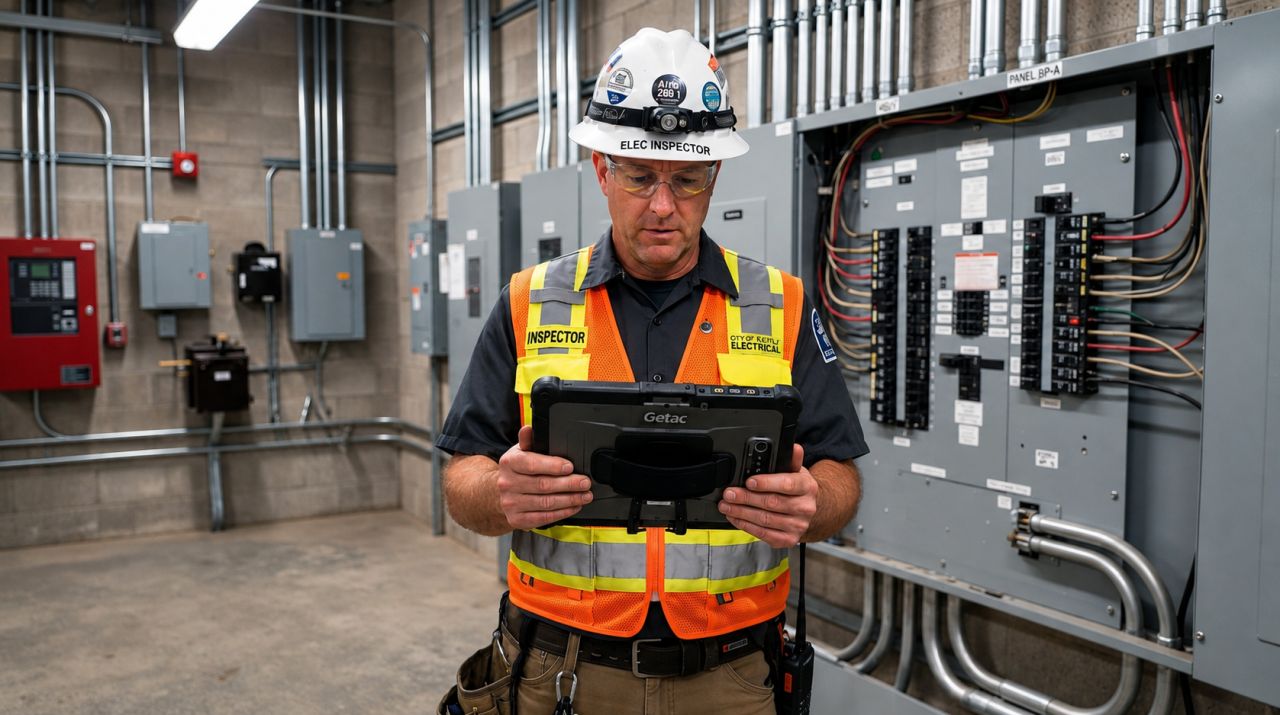
QCxC does not perform construction, installation, or remediation work of any kind. We assess; we do not build. That separation is the whole basis of the finding — there is no work of ours for our own audit to be judged against, and no incentive to soften a result.
We publish that separation because you should be asking the question of anyone you engage in this role — and because the answer is worth more to you than the revenue is to us.
The audit is the entry point. It's scoped, fixed-deliverable, and it produces a document you can hand to your owner. Tell us about the project and we'll come back with a scope and a schedule.
Each service produces the evidence that justifies the next one. Audit findings scope the training. Training closes the findings. The contracted program keeps them closed through every phase transition.
A scored, independent assessment of your project's foreign object exposure — delivered as a document your quality director can forward to the owner without editing it.
Typical on-site duration and standard report turnaround: information supplied upon request.
A QCxC technician works the site against a fixed audit card covering seven domains. Every element carries a stable code and is scored on a 0–4 maturity scale. Findings are attributed with a mandatory co-witness rather than photographed, and the scoring engine is deterministic — the same inputs return the same score on any day, by any auditor.
Executive risk summary. Your FOE Readiness Index (0–100), domain rollups, and the two or three exposures that matter most, written for a project executive.
Assignable deficiency list. Every finding, coded, severity-classified, and written so it can be assigned to a responsible party with a due date. Not observations — work items.
Program assessment narrative. The written analysis of why the program is scoring where it is, and what closes the gap.
Re-audits at phase transitions carry the prior score forward, so the report shows trend rather than a fresh snapshot.
Delivered on your site, on your schedule, against the standards that define the discipline.
Because our training modules share the same element codes as the audit, an audit finding maps directly to the module that closes it. Your lowest-scoring codes are your curriculum — you're not buying a generic course.
Workforce awareness. Short-form, all-trades orientation. What FOD is, why this building is different, and what each person is responsible for.
FOE technician certification prep. Structured preparation for the NCATT Foreign Object Elimination examination, including exam administration coordination through a remote-proctored platform.
Train-the-trainer. For organizations building internal capability. We qualify your people to deliver the program themselves.
Recurring recertification. Scheduled refresh for crews on long-duration projects and for operational facilities.
For teams that need the program to exist and run, not to be advised on.
Under a contracted monthly engagement, QCxC authors and administers the Foreign Object Elimination program on your project. That means the written program and subcontractor flow-down language, the three-tier zone designation and its boundary controls, scheduled field verification, finding intake and closure tracking, root cause and corrective action management, pre-energization and phase-gate sweeps, and monthly trend reporting formatted for owner distribution.
Engagement tiers scale with white space, project duration, and the number of subcontractors in scope. Term commitments carry a discount.
Clients under a contracted program receive a login scoped to their own findings, with closure evidence upload and status tracking — the report stops being a document and becomes a live system.
Two capabilities are being brought online in stages as credentialing completes. We'd rather name them accurately than sell them early.
QC/QA program management and inspection. Independent quality oversight — program development, hold point management, nonconformance tracking, and reporting that goes to the owner.
Electrical testing and commissioning support. Systems verification coordinated with the project's commissioning agent rather than duplicating them.
If either is on your critical path, tell us your timeline and we'll be straight with you about whether we can serve it.
Your QC manager is accountable to the same schedule as the work being inspected. That isn't a criticism — it's the structure. An independent assessor has no schedule exposure, no scope on the project, and no reason to soften a finding. We also bring a fixed instrument: the same seven domains, the same coded elements, the same scoring rules, applied identically on every site. That repeatability is what makes a score defensible when it's forwarded to an owner.
No — and not because we can't. It's a design decision. Camera-based audit methods routinely stall in security review on hyperscale and federal-adjacent sites. Ours doesn't. Every finding instead carries a mandatory co-witness attribution, which is a stronger evidentiary record than an undated photo with no named observer.
No. Maturity levels, severity assignment, and domain rollups are computed by fixed rules from the technician's inputs. No model touches the score. The only generated content in the report is the narrative prose, and it is written from scores that have already been computed. If the same site could score differently on two different days, the report would be worthless the first time it was disputed.
No, and we won't tell you otherwise. Those standards — along with the NCATT FOE Standard, ASTM F3617-22, and ASHRAE TC 9.9 — are benchmarks our framework is measured against and the basis on which we assess yours. They are not accreditations we hold. Any firm telling you it is "ISO 14644 certified" for this kind of work is worth a second look.
No. QCxC performs no construction, installation, or remediation work of any kind, on any project. We assess; we never build. There is no scope of ours for our own audit to be checked against.
Per-client data isolation is built in from day one, not retrofitted. Your findings are visible only to you. We'll sign your NDA before a scoping call if you'd prefer, and our retention and deletion policy is published rather than negotiated case by case. PLACEHOLDER — final retention terms to be confirmed by QCxC before launch.
Audits are fixed-fee and scoped to facility size, project phase, and the number of area tiers in play. Training is priced per seat with volume tiers, and contracted programs are monthly with a discount for term commitments. We quote after we understand the project — send the audit request form and you'll have a written scope and fee back quickly.
Foreign object control began in aviation, where the consequence of a loose fastener is not negotiable. A pre-flight check is sequential, it uses a fixed card, no item is skipped silently, it is signed, and it happens before the thing that matters. We brought that structure to mission-critical construction unchanged.
Each domain owns questions no other domain asks, so nothing falls between two reviewers and nothing is counted twice. Domain scores roll up by consequence weight into a single index.
| Code | Domain | Jurisdiction | Weight |
|---|---|---|---|
| PG | Program & Governance | Written FOE program, management commitment, accountability, stop-work authority, subcontractor flow-down | 10 |
| ZB | Zones & Boundaries | Three-tier area designation, control lines, transition points, signage, entry and exit discipline | 16 |
| PC | People & Competency | Orientation, awareness training, role-specific competency, subcontractor onboarding, visitor and escort control | 8 |
| TM | Tool & Material Accountability | Tool control, shadow boards, tethering, consumables, hardware and fastener control, shift-end inventory | 20 |
| HD | Housekeeping & Debris Egress | Clean-as-you-go, containment during cutting, drilling and pulling, wire trimmings, waste routing, equipment covers | 18 |
| DR | Detection, Reporting & Response | Find reporting, reporting culture, root cause, corrective action closure, trend data | 12 |
| LT | Lifecycle & Transition Readiness | Phase-gate integration, pre-energization sweeps, equipment closure verification, closeout and handoff | 16 |
Governance is weighted lower than instinct suggests. A binder does not keep hardware out of a switchgear cubicle.
Every element is scored 0 to 4. Element scores average within their domain, domain scores are weighted by consequence, and the result normalizes to the FOE Readiness Index on a 0–100 scale.
No provision exists.
Practiced informally. Personality-dependent and undocumented.
Documented and communicated, but execution is inconsistent.
Documented, executed consistently, verified locally.
Implemented, plus objective evidence of monitoring, trending, and correction.
Findings are additionally classified on a four-level severity taxonomy, ranging from an S1 condition requiring immediate containment down to a program observation: S1 Critical (immediate containment), S2 Major, S3 Minor, S4 Observation. Severity drives the assignable deficiency list; maturity drives the index.
Not a limitation — a design decision. Camera-based audit methods stall in security review on hyperscale and federal-adjacent sites. Ours doesn't. Every finding instead carries a mandatory co-witness attribution, which is a stronger evidentiary record than an undated photo.
Maturity levels, severity assignment, and domain rollups are computed by fixed rules from the technician's inputs. If the same site could score differently on two days, the report is worthless the moment it's disputed. Only the narrative prose is generated, and only from scores already computed.
Authored by QCxC against a twelve-element framework and the three-tier area designation. Industry standards are the benchmarks the framework draws on. No question, scale, or passage is reproduced from any standard or study guide.
Data center white space is not a place with reliable connectivity, and a method that depends on signal is a method that fails on the day it matters.
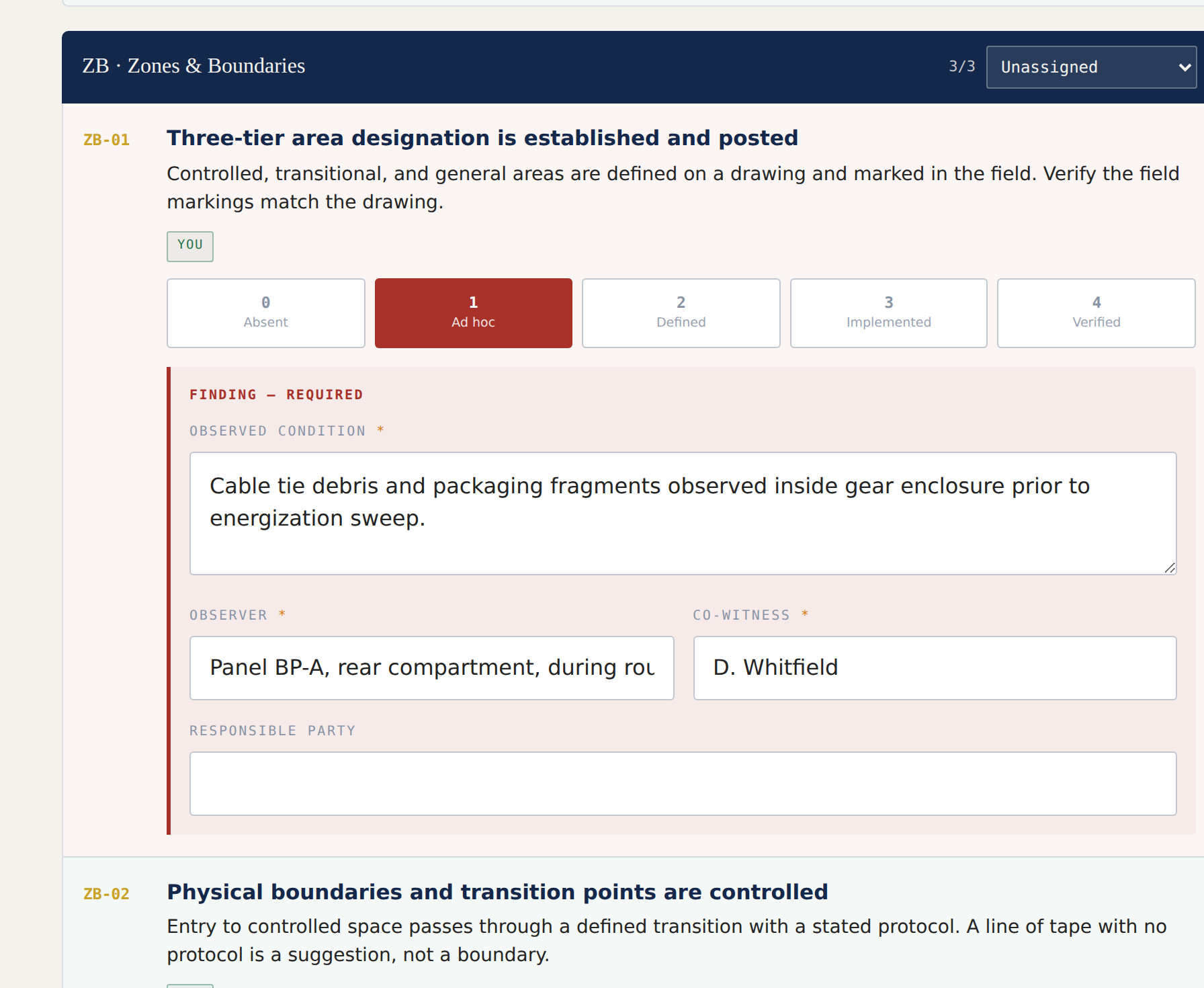
Our field application runs the complete audit card offline and syncs later. Applicability logic adapts the card to project phase and area tier, so a technician is never scored against elements that don't apply to the space they're standing in. The deliverable is generated on site.
The bar we set: a technician completes a full audit on a tablet, offline, and sends you a branded PDF before leaving the parking lot.
Actual screen from the field application, mid-assessment.
Our framework is built against the documents that define foreign object control and mission-critical environmental discipline.
Foreign object discipline only works if it's held by the crews doing the installation — not by the firm auditing them. We train workforces directly, whether or not you ever engage us for an audit.
You don't need an active job or an audit. Training stands alone.
Your facility, your yard, your trailer, or your training room. We come to the crew.
We prepare candidates and coordinate remote-proctored examination.
Our firewall governs program oversight, not instruction. We can train anyone.
Subcontractors building a bench. Mission-critical owners increasingly ask what your people are trained to before they ask what you charge. A credentialed crew is a bid differentiator that survives the low-bid conversation.
General contractors with self-perform scope. You carry the FOE requirement contractually and need documented evidence that your own workforce meets it, separate from what your subs can prove.
Facility owners and operators. Your in-house maintenance staff work in live white space where a dropped fastener has different consequences than it does during construction. Construction-phase training doesn't cover that.
Workforce and staffing organizations. Trade schools, apprenticeship programs, and staffing firms placing people into data center work. A credential attached to a placement is worth more than a résumé line.
Most organizations start with awareness across the whole workforce, then certify a smaller group of coordinators who carry the program day to day.
Contact hours, minimum and maximum cohort size, and materials included are noted per program below. No pricing on this page under any circumstances.
For: Every trade on site, plus visitors and escorts. No prerequisites.
Format: Short-form, instructor-led. Delivered at orientation or as a standalone toolbox session, in shifts if production can't stop.
Duration: Contact for details Cohort: Contact for details
Participants leave with: Working knowledge of area tier designations, tool and hardware accountability expectations, what to do when they find something, and why reporting a find is protected rather than punished.
You leave with: A signed roster you can produce when an owner or GC asks for training evidence.
For: Quality personnel, foremen, FOE coordinators, and anyone who will hold program responsibility.
Format: Structured instructor-led preparation built against the NCATT Foreign Object Elimination Standard, with examination coordinated through a remote-proctored platform.
Duration: Contact for details Cohort: Contact for details
Participants leave with: Exam readiness and a working command of program elements, area tiering, and accountability systems.
Read the next section carefully on what this credential is and who issues it.
For: Organizations building permanent internal capability rather than buying instruction repeatedly.
Format: Instructor qualification covering delivery method, the question bank's structure, and how to assess competency rather than attendance.
You leave with: Qualified internal instructors and a licensed materials set.
For: Long-duration projects with crew turnover, and operational facilities where staff work in energized white space.
Format: Scheduled refresh on a fixed cadence, updated to reflect standard revisions and lessons from the field.
Cadence: Contact for details
Why it matters: Awareness decays. A crew trained eighteen months ago on a project that has since turned over twice is not a trained crew, and an owner asking for current evidence won't accept a stale roster.
NCATT certifies individuals. QCxC prepares them. Those are different things and we won't blur them.
Completing a QCxC course is not a certification. It is preparation for an examination administered by a certifying body, and the credential that results belongs to the individual who earned it — not to your company and not to us.
We coordinate examination through a remote-proctored platform, which means candidates can sit the exam without travel. Information on the platform and current proctoring arrangement is supplied upon request.
If a competitor tells you their course confers a certification, ask which body issues it and ask to see the accreditation. It's a fast question and the answer is informative.
Where. Your jobsite trailer, your yard, your shop, your training room, or a facility you arrange. We travel across Atlanta, Charlotte, Huntsville, and Nashville as standard, and nationally for larger cohorts.
When. Scheduled around production, including shift splits, early starts, and Saturdays. Training that shuts down a crew for a full day is training that gets canceled.
Language and literacy. Spanish-language delivery is available.
Materials. Participant workbook, wallet card, digital roster, and completion documentation included with every program.
Site access. We complete your badging, orientation, and background requirements like any other vendor. Tell us the process on the scoping call and we'll start it early.
Training modules and audit elements share the same code taxonomy. That isn't a convenience — it's the architecture.
If QCxC has audited your project, your lowest-scoring element codes are your curriculum. You are not buying a generic course and hoping it covers the gap; you're buying the specific modules that close the specific findings, and the re-audit measures whether they closed.
Training alone works perfectly well without this. But if you're buying both, they're built to interlock.
No. Training is a standalone service and many clients buy it without ever engaging us for an audit. The two interlock if you buy both, but neither requires the other.
Minimum 8 per program. Individuals can also join a scheduled open cohort rather than booking a private session.
The certification examination is administered by the certifying body, not by us, and we don't control outcomes or guarantee results. What we control is preparation: structured instruction against the standard, practice against the element framework, and an honest read on whether a given candidate is ready to sit.
Yes. Instruction and independent assessment are separable, and closing a finding you identified is the normal shape of a quality relationship.
Yes. Every session produces a signed roster and completion documentation formatted so it can be handed to a general contractor or owner without editing. Several owners now require training evidence at orientation — this is the artifact that satisfies it.
Training is priced per seat with volume tiers, and train-the-trainer is quoted per engagement. We quote after we know the cohort size, the mix of programs, and where delivery happens. Send the request below and you'll have a written scope back quickly.
No project details required — this is about your people. We reply within one business day with a scope, a schedule, and a fee.
If you have an active project and want it assessed, use the audit request form.
Mission-critical clients rarely permit their names on a vendor's website, and we don't ask them to. What follows is described by facility type, phase, and scope rather than by owner.
Every project card below is scaffolding. QCxC supplies real content per card: facility type, market, project phase, scope delivered, and outcome. Publish nothing here until QCxC confirms each entry and confirms that any named client has given written permission. If real engagements aren't ready at launch, remove this page from the navigation rather than shipping placeholder cards.
Pond Media still or approved owner image
SUMMARY — Two to three sentences describing the exposure that prompted the engagement and what QCxC delivered.
Pond Media still or approved owner image
SUMMARY — Two to three sentences describing the exposure that prompted the engagement and what QCxC delivered.
Pond Media still or approved owner image
SUMMARY — Two to three sentences describing the exposure that prompted the engagement and what QCxC delivered.
Pond Media still or approved owner image
SUMMARY — Two to three sentences describing the exposure that prompted the engagement and what QCxC delivered.
Pond Media still or approved owner image
SUMMARY — Two to three sentences describing the exposure that prompted the engagement and what QCxC delivered.
Pond Media still or approved owner image
SUMMARY — Two to three sentences describing the exposure that prompted the engagement and what QCxC delivered.
Project cards are for people evaluating fit. This section is for people filling out a qualification package — structured past performance entries with the fields that appear on prequalification forms and federal source selection criteria.
Each entry below is an empty past performance record. QCxC supplies every field. Publish nothing here until each entry is confirmed and, where a client is identifiable, written permission is on file.
Two cautions. First, past performance on federal work is a formal evaluation factor and may be subject to CPARS or contract-specific disclosure rules — confirm what can be published before publishing it. Second, do not present work performed by another company or by an individual at a prior employer as QCxC past performance. Where relevant experience belongs to a person rather than the firm, present it in the leadership biographies and label it as individual experience.
SCOPE NARRATIVE — Three to four sentences: what QCxC was engaged to do, the phases covered, the deliverables produced, and the measurable result. Write it so it can be pasted directly into a prequalification form without editing.
SCOPE NARRATIVE — Three to four sentences: what QCxC was engaged to do, the phases covered, the deliverables produced, and the measurable result.
Keep entries reverse-chronological. If QCxC has no completed engagements at launch, remove this entire section and the Projects page from navigation, and rely on the individual experience described in the leadership biographies instead.
Hyperscale and federal owners restrict disclosure of vendor relationships, and quality findings are commercially sensitive by nature. We treat that as a feature of working in this market, not an obstacle to marketing.
If you need references during a vendor qualification, we'll provide them directly and confidentially — with the client's permission, to a named person, under whatever agreement your procurement process requires.
QCxC — Quality Control and Commissioning — is a professional services firm specializing in Foreign Object Elimination for mission-critical construction. We hold no installation scope on the projects we assess. We are the independent set of eyes that verifies the work of others.
Data center construction in the Southeast is absorbing more volume than its quality capacity has scaled to meet. Craft labor is stretched, which puts more crews on mission-critical work who are newer to its tolerances. Schedules compress, which pushes quality activities toward the end of a project where they're least effective. Owner expectations have risen faster than program maturity has.
Those conditions together describe exactly the environment where foreign object problems get built into buildings — sealed behind panels, energized, and discovered later at a cost measured in outage hours rather than in labor.
QCxC was built to be the capacity that closes that gap: an outside firm with no scope on the job, a fixed method, and the standing to say something is wrong.
QCxC, LLC holds no construction, installation, or remediation scope on any project, anywhere. We assess; we do not build. There is no work of ours for our own findings to be measured against, and no revenue link between a score and a contract.
We publish this because a quality function that can be quietly compromised is not a quality function. You should ask this question of anyone you engage in this role. Here is our answer before you have to ask it.
Atlanta. Charlotte. Huntsville. Nashville.
That wasn't arbitrary — it's where the construction volume is, and being regional means we can be on your site the same week rather than the same month. We understand the trade base, inspection culture, and schedule pressure of these four markets specifically, rather than applying a template from somewhere else.
We travel outside the corridor for contracted program engagements.
Independent quality work does not scale by adding headcount. It scales by being right. Every engagement is staffed by a named individual you meet before the contract is signed — you will not be handed off to someone you have never spoken with.
Bios below are drafted from internal material and must be confirmed by each individual. Years of experience, surnames, titles, and every credential line require sign-off. Name and title only — no headshots.
Founder of QCxC. VERIFY years in electrical construction and mission-critical delivery, now focused on building QCxC into an independent quality practice serving the projects he spent his career installing.
Sets the firm's independence policy and personally scopes every initial engagement.
Leads program development, field assessment, and training delivery. Holds federal quality control and assurance experience, including independent stop-work authority on an active federal firm-fixed-price contract — authority he has exercised, which is a different thing from holding it.
Authors the audit question bank and personally trains every technician who carries the card.
Leads scope development and preconstruction planning, translating audit findings and program requirements into work that fits a real construction schedule rather than an idealized one.
EXPAND — background, years of experience, and prior project types to be supplied.
Manages engagement delivery and field coordination across active projects — scheduling, site access, badging, and client communication through the life of an engagement.
Commissioning credentialing in progress as part of the firm's expanding testing and commissioning capability.
You meet the technician who will be on your site before you sign anything.
Every person who carries an audit card is trained by our program lead on the same question bank, using the same applicability rules, against the same scoring model. Consistency between auditors is not an aspiration here — it's the product. A score that varies by who showed up is not a score.
For contracted programs, one named program manager owns the relationship for the duration. Continuity matters more on a two-year build than on a two-day audit.
If you've run quality on mission-critical work and you're tired of being accountable to the schedule you're supposed to be checking, we should talk.
A firm that assesses other people's programs should be willing to publish its own. These are the commitments we hold ourselves to, and they are the ones you should hold us to.
QCxC performs no construction, installation, or remediation work of any kind. We also decline engagements where our fee is contingent on the score, where the scope excludes a domain the client would rather not have assessed, or where a finding must be routed through the party responsible for it before reaching the owner.
Our technicians work to the site safety program of whoever controls the site, plus our own standards, whichever is stricter. We participate in your orientation, your badging, and your daily briefings like any other trade on site.
EMR, OSHA 10/30 coverage, and safety program certifications: to be supplied upon request.
Per-client data isolation is built into the field system from day one rather than retrofitted. Your findings are visible only to you. We record no photographs or video on any site, which is both a security posture and a privacy one.
PLACEHOLDER — publish the final retention period, deletion-on-request terms, and the written commitment that client data is never used to improve our tools without consent.
We reference standards as benchmarks our framework is measured against, never as accreditations we hold. Capabilities still in credentialing are described as in progress, on this site and in every proposal. If a competitor's claim sounds stronger than ours, it's worth asking them to produce the certificate.
A finding you disagree with is a conversation, not a verdict.
Every report includes a documented path to challenge a finding, and disputed items are re-scored against the same fixed rules rather than negotiated. Because the scoring is deterministic, that re-score is a check of the inputs — not a matter of opinion.
If you believe a QCxC technician behaved improperly on your site, or a finding was influenced by anything other than the audit card, contact leadership directly at Support@QCxC.Net.
Writing on foreign object elimination, quality capacity, and the economics of mission-critical construction. Most of it originates on LinkedIn, where the conversation actually happens.
Titles and summaries are drawn from published and drafted QCxC material. Every href below points to # and must be replaced with the live LinkedIn article URL. Dates require confirmation. Where an article has not yet been published, remove the row rather than linking to nothing.
Naming the hazard is not the same as running the program that eliminates it. What the distinction means on a live data center build, and why most projects have the first without the second.
Read the articlePLACEHOLDER — LINKEDIN ARTICLE URL TO BE SUPPLIEDLong-lead equipment sitting on site with panels open is the most under-managed window on a mission-critical project. Why risk tracks enclosure exposure rather than construction progress.
Read the articlePLACEHOLDER — LINKEDIN ARTICLE URL TO BE SUPPLIEDA stretched craft pipeline puts more crews on mission-critical work who are newer to its tolerances, while quality staffing hasn't scaled with construction volume. The capacity gap that creates, and who fills it.
Read the articlePLACEHOLDER — LINKEDIN ARTICLE URL TO BE SUPPLIEDOn the structural economics of construction subcontracting, the difference between revenue and durable margin, and why annuity-style service work changes the shape of a contracting business.
Read the articlePLACEHOLDER — LINKEDIN ARTICLE URL TO BE SUPPLIEDISO 14644-1 Class 8, AS9146, and ASHRAE TC 9.9 get cited constantly and understood rarely. What each one covers, what it doesn't, and how OEM installation requirements reference them.
Read the articlePLACEHOLDER — LINKEDIN ARTICLE URL TO BE SUPPLIEDDuplicate this row structure for each additional published article. Keep the list reverse-chronological.
Read the articlePLACEHOLDER — LINKEDIN ARTICLE URL TO BE SUPPLIEDWe publish on foreign object elimination, quality capacity, and mission-critical construction several times a week.
Most quality people in construction report, directly or indirectly, to someone accountable for the schedule they're supposed to be checking. We built this firm specifically so that isn't true here.
Our technicians carry a fixed audit card and a deterministic scoring model. That means a finding you record is a finding that stands — it isn't renegotiated in a trailer, softened for a relationship, or quietly dropped because a phase gate is close.
It also means the work is genuinely rigorous. You will be trained on the full question bank by our program lead, you will be expected to apply it identically every time, and every finding you enter carries your name and a co-witness.
Travel is regional — Atlanta, Charlotte, Huntsville, Nashville — with occasional national travel on contracted programs.
There's no fixed posting list. We hire ahead of demand when the right person appears, particularly for people with mission-critical quality, FOE, or commissioning backgrounds.
Eight questions. Most take under four minutes. We reply within one business day with a scope, a schedule, and a fee — or with a straight answer that an audit isn't what you need yet.
Response time: within 24 hours.
Skip the form. Book a scoping call or call the number in the footer.
We don't share project information with anyone outside QCxC, and we'll sign your NDA before the call if you'd prefer.
Twenty minutes, no deck. We'll ask about your phase, your area tiers, and where you think the exposure is. If we're not the right fit we'll say so on the call.
EMAIL
Support@QCxC.Net
MARKETS SERVED
Atlanta · Charlotte · Huntsville · Nashville
Ready to move on a specific project? The audit request form gets you a scope faster than a call will.
Hiring inquiries go to Careers. Media and speaking requests, use the form above.
This is a structural outline of the sections a privacy notice for this business needs. It is not legal advice and must not be published as written. QCxC should have counsel draft or review the final text, particularly around client project data, which is commercially sensitive and may be subject to client-specific contractual obligations.
Last updated: DATE TBD
DRAFT — Information submitted through the audit request form and contact forms: name, title, company, work email, phone, and project details. Standard web analytics data. No sensitive personal categories are collected.
DRAFT — To respond to service requests, prepare scopes and proposals, and communicate about engagements. Describe any marketing use, and whether consent is required.
DRAFT — Audit findings and project information collected during engagements are held under per-client isolation and are not shared outside QCxC. State the retention period, the deletion-on-request process, and the commitment that client data is not used to train or improve tools without written consent.
DRAFT — QCxC records no photographs or video during site assessments. Confirm and state plainly; this is a differentiator worth putting in the privacy notice.
DRAFT — List processors: form handler, email provider, analytics, scheduling platform, hosting.
DRAFT — Describe what is set and why. If any non-essential cookies are used, a consent mechanism may be required depending on visitor jurisdictions.
DRAFT — Access, correction, and deletion requests. Note applicable state privacy laws for the jurisdictions where QCxC operates and where site visitors are likely located.
PRIVACY CONTACT TBD
QCxC is committed to making this site usable by everyone, including people using assistive technology.
This site is designed and built targeting WCAG 2.1 Level AA. That includes keyboard operability throughout, visible focus indicators, semantic heading structure, text alternatives for meaningful non-text content, color contrast meeting AA thresholds, and respect for reduced-motion preferences.
DEVELOPER — list any third-party embed (scheduler, form handler, video player) that has not been independently verified for conformance. Being specific here is better than a blanket claim.
DEVELOPER — record the date of the most recent audit, the tools used, and whether screen reader testing was performed. Update after any significant change.
If you encounter something on this site you cannot access, contact us at Support@QCxC.Net and we will provide the information in another format and work to correct the issue.
Outline only. Not legal advice. QCxC should have counsel draft the final text.
DRAFT
DRAFT — Important for this business: content on this site is general information about foreign object elimination practice and does not constitute a site-specific assessment, safety determination, or engineering judgment. Nothing here creates a professional relationship.
Standards named on this site are referenced as benchmarks against which QCxC's framework is measured. QCxC holds no certification or accreditation to any standard referenced herein. Standard names and marks remain the property of their respective owners.
DRAFT — The QCxC audit framework, question bank, element taxonomy, and scoring model are proprietary. State ownership and permitted use of site content.
DRAFT
DRAFT